Mary Celestia
Lost 1864 - Confederate blockade-runner, iron side-paddle steamer
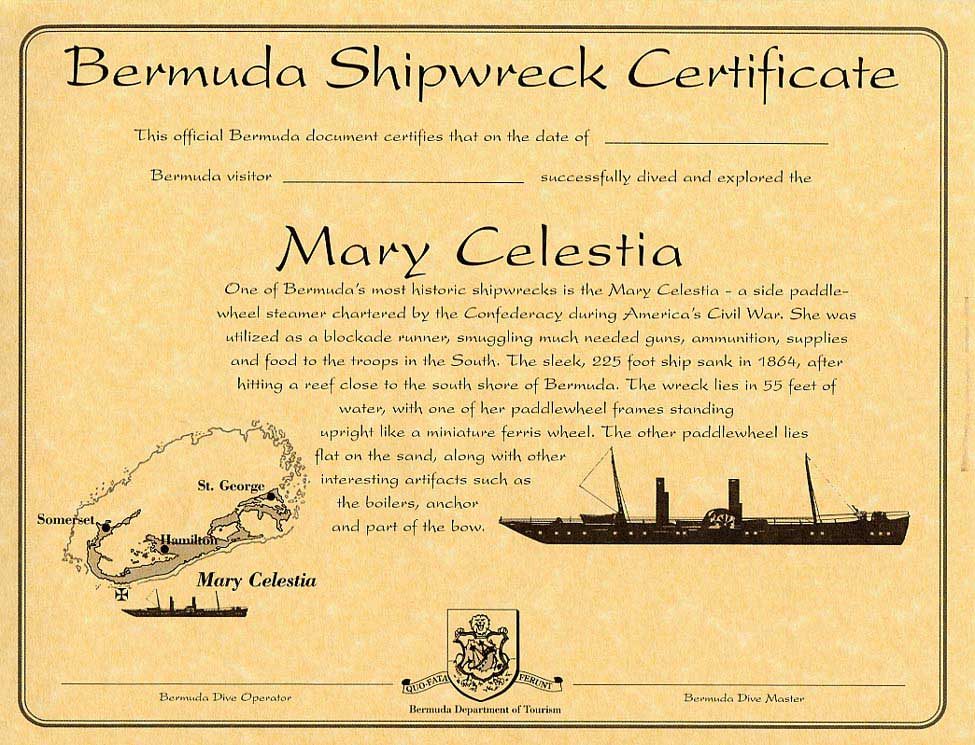
Image courtesy of the Government of Bermuda.
History
The Mary Celestia was one of the fast, low paddle steamers built in Britain to run the Union blockade of Confederate ports during the American Civil War. Completed in Liverpool in 1864 for the blockade-running firm Crenshaw & Co., she shuttled between Bermuda and Wilmington, North Carolina, carrying war supplies in and cotton out, and sometimes used other names to confuse Union agents.
On 6 September 1864 she left Bermuda bound for Wilmington. The Bermudian pilot, John Virgin, took her close inshore along the South Shore, reportedly to land passengers, and she struck a reef south-east of Gibbs Hill Lighthouse. She went down in a matter of minutes. Much of her cargo was salvaged and auctioned at the time, and the wreck was worked again in the 20th century.
Storms in 2009-2010 scoured sand from the bow and exposed the forepeak, revealing sealed bottles of wine, perfume bottles and other goods. To protect them, a team including Bermuda's Custodian of Historic Wrecks and NOAA archaeologists excavated the forepeak in June 2011, recovering well-preserved woodwork, wine and personal items, some possibly hidden contraband.
Diving the wreck today
The wreck lies on sand at about 55 ft, close to the reef that sank her. One paddlewheel frame still stands upright like a skeleton wheel, the other lies flat, and the boilers, anchor and parts of the bow are easy to find. The surrounding reef has gullies and swim-throughs.
It is a straightforward dive for open-water divers in calm South Shore conditions and one of Bermuda's best-known Civil War sites. Leave everything in place; the site is protected.
Where it is
Approximate position, for interest only - never use for navigation.
Sources & further reading
- Department of Environment and Natural Resources - Mary Celestia
- NOAA - Archaeological excavation of the forepeak of the Civil War blockade runner Mary Celestia (Delgado et al. 2016)
- Bermuda Monetary Authority - Mary Celestia coin (2006 shipwreck series)
- National Geographic - Civil War wine from the Mary Celestia
- Bermuda 100 (UC San Diego) - The Mary Celestia
- Bermuda.com - Bermuda's Shipwreck Postage Stamps (1986 set)